The Talent You Can't See on a CV: Are We Missing Out on Great People?
By Jobnix Team
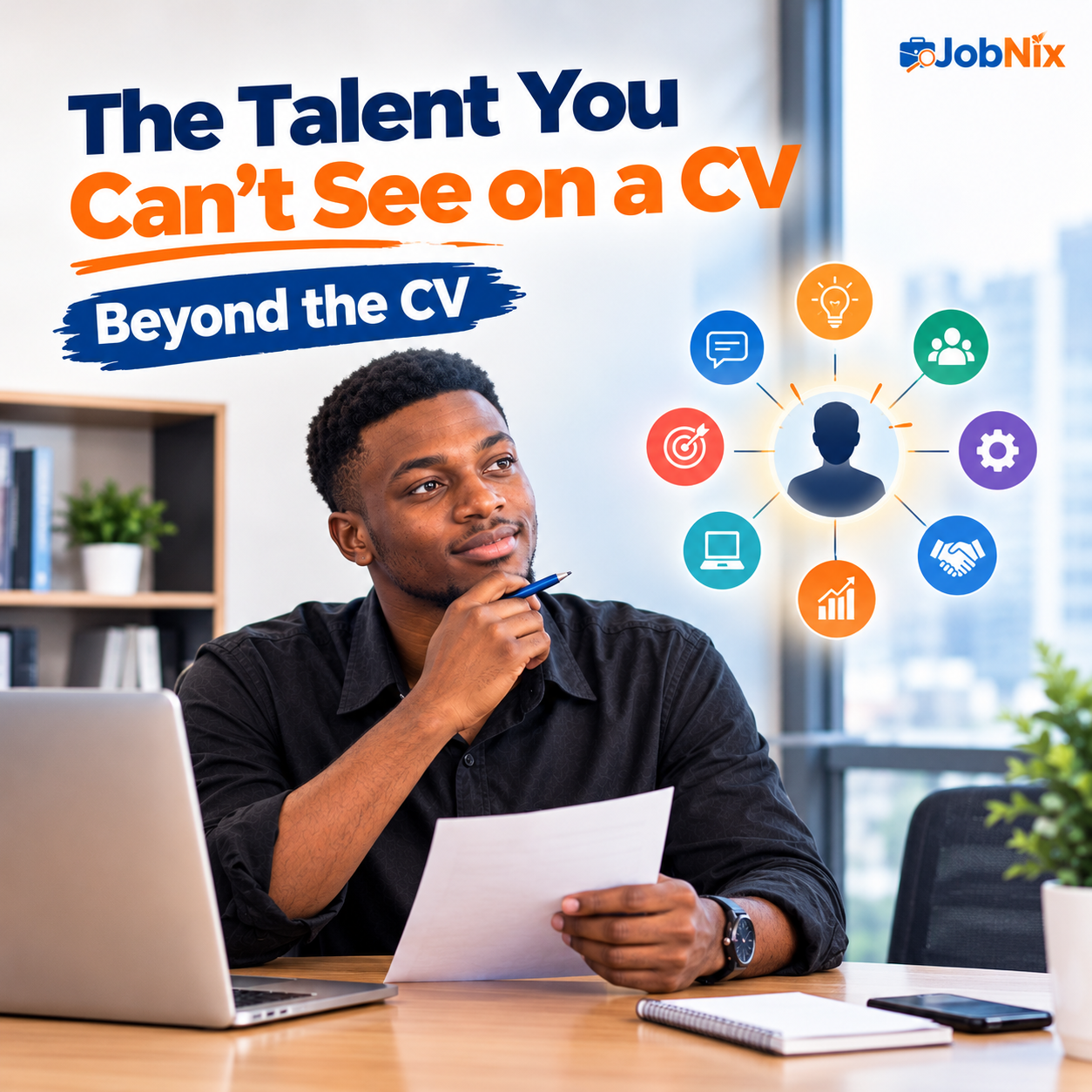
Imagine reviewing two CVs for the same position.
The first candidate graduated from a prestigious university, has worked for two well-known companies, and has an impressive list of professional qualifications.
The second candidate has no experience working for a major organisation. Their career path looks unconventional, and their qualifications may not immediately stand out.
Based on their CVs alone, you might choose the first candidate.
But what if the second candidate has spent years solving real-world problems, building projects, managing people, learning independently, and developing skills that are directly relevant to the role?
What if their experiences have taught them how to adapt quickly, think creatively, and deliver results under pressure?
Would you still make the same decision?
This is one of the limitations of the traditional CV. While it remains an important professional document, it cannot always capture the full range of a person's abilities.
And when we rely on it too heavily, we risk overlooking talent that could make a real difference.
A CV Tells Your Story, but Not the Whole Story
A CV is designed to communicate relevant professional information.
It tells employers where you studied, where you worked, what responsibilities you held, and which qualifications you earned.
These details matter.
However, a CV often presents a person's professional life through a relatively narrow lens.
It may tell you that someone worked as a customer service representative for three years, but it might not explain how they handled difficult customers, improved a process, or helped retain important clients.
It may tell you that someone studied computer science, but not whether they have built applications, contributed to open-source projects, or independently developed practical technical skills.
It may tell you that someone has never held a formal job, but not that they have managed a business, organised community initiatives, or completed projects that demonstrate their abilities.
The information is not necessarily inaccurate. It is simply incomplete.
A CV shows parts of a person's professional journey. It does not always reveal everything that journey has taught them.
Some of the Best Skills Are Developed Outside the Workplace
We often associate professional skills with formal employment.
We imagine that people become good at managing projects by working as project managers, develop sales skills by working in sales, and learn leadership by occupying leadership positions.
Sometimes, that is exactly how it happens.
But people also develop valuable skills outside traditional employment.
Consider a young Nigerian who runs an online clothing business while attending university.
To keep the business operating, they may need to communicate with customers, negotiate with suppliers, manage orders, create marketing content, track expenses, and resolve complaints.
These responsibilities can develop practical skills in communication, sales, customer relationship management, operations, and financial organisation.
Now consider someone who has spent years organising events in their community.
They may have experience coordinating people, managing budgets, negotiating with vendors, planning activities, and handling unexpected problems.
Neither person should automatically be considered qualified for every role involving these skills. Their actual capabilities still need to be assessed.
However, their experiences could provide evidence of abilities that a conventional CV might not fully communicate.
The challenge is recognising these experiences and translating them into language that employers and collaborators understand.
The Problem With Judging People by Job Titles
Job titles can be useful indicators of experience, but they can also be misleading when treated as complete descriptions of a person's abilities.
Two people with the same job title may have very different levels of responsibility, practical experience, and expertise.
Meanwhile, two people with different job titles may possess remarkably similar skills.
A social media manager and an entrepreneur, for example, might both have experience creating content, analysing audience engagement, developing marketing strategies, and building online communities.
A teacher and a corporate trainer might both be skilled at explaining complex ideas, facilitating learning, and adapting communication to different audiences.
A small business owner and an operations professional might both have experience coordinating resources, managing processes, and solving logistical problems.
Their backgrounds differ, but their skills may overlap.
If employers look only at job titles, they could miss candidates whose experience translates well into the role.
Looking beyond titles does not mean ignoring professional standards. It means asking better questions about what someone has actually done and what they can demonstrate.
Instead of asking only, "Have you held this position before?" we can also ask, "Have you performed similar tasks, solved related problems, or developed the skills required to succeed?"
That shift could help organisations identify candidates they might otherwise overlook.
The Talent Hidden in Career Gaps and Unconventional Paths
Not everyone's career follows a straight line.
Some people graduate and immediately secure formal employment. Others spend years searching for their first opportunity.
Some change careers after discovering new interests. Others take breaks to care for family members, build businesses, pursue education, or deal with circumstances beyond their control.
These experiences can affect how a CV looks.
A candidate with employment gaps may be viewed less favourably than someone with a continuous career history. Someone who has changed industries several times may struggle to explain how their experiences fit together.
Yet, a non-linear career does not automatically indicate a lack of ability or commitment.
Someone transitioning into technology may have spent months building projects and learning new tools.
Someone returning to work after a career break may have valuable experience and updated skills.
Someone who has worked across several industries may have developed adaptability, broad perspectives, and the ability to learn unfamiliar processes.
The important question is not whether every career path looks conventional.
It is whether the person's skills, experience, and capabilities are relevant to the opportunity.
Of course, some roles require specific qualifications, licences, or demonstrable experience. Those requirements should not be ignored.
But where different pathways can lead to the necessary skills, hiring processes should leave room to recognise them.
How Do We Discover the Talent a CV Misses?
If a CV cannot tell the whole story, what else can we use?
The answer is not necessarily to abandon CVs. It is to complement them with better ways of understanding people's abilities.
1. Portfolios and practical projects
Work samples can provide evidence of what someone can do.
A designer can showcase their designs. A developer can demonstrate an application they have built. A writer can share published articles. A marketer can explain a campaign they managed and the results it achieved.
Where confidentiality permits, practical examples can make skills easier to evaluate.
2. Skills-based assessments
When appropriate, candidates can be evaluated through tasks that reflect the actual requirements of a role.
A writing candidate might complete a writing exercise. A developer might solve a relevant technical problem. A customer service candidate might respond to realistic customer scenarios.
Assessments should be fair, accessible, relevant to the job, and proportionate to the time and effort expected from candidates.
3. Evidence of transferable skills
Experience gained outside formal employment can be valuable when it is relevant to the opportunity.
Candidates should be encouraged to explain what they did, the challenges they faced, the skills they used, and the outcomes they achieved.
Specific examples are more informative than vague claims about being hardworking, creative, or resourceful.
4. Professional profiles
A professional profile can bring together projects, skills, experience, achievements, and professional interests in one place.
Unlike a traditional CV, it can be updated as a person learns, builds, and grows.
It can also help people communicate their abilities when their professional experience does not fit neatly into conventional categories.
5. Better conversations
Sometimes, discovering talent begins with asking a different question.
Instead of focusing entirely on where someone has worked, ask them to describe a difficult problem they solved, something they built, a skill they learned independently, or a project they are proud of.
These conversations cannot replace rigorous evaluation, but they can reveal useful information that a CV alone might not communicate.
The Responsibility Is Not Only on Employers
Candidates also have a role to play in making their abilities visible.
If you have skills that do not appear clearly on your CV, think about how you can demonstrate them.
Document your projects. Build a portfolio where relevant. Record meaningful achievements. Explain the responsibilities you have handled, even when they came from informal work or personal initiatives.
Instead of writing only that you managed a business, describe what you managed, the challenges you addressed, and the outcomes you achieved.
Instead of saying you are good at communication, provide examples of situations where effective communication made a difference.
If you are learning a new skill, consider building a project that demonstrates your progress.
You do not need an impressive job title to start building evidence of your abilities.
At the same time, employers and organisations must be willing to look beyond familiar credentials when the role allows it.
It is not enough to tell people to showcase their talent if hiring processes continue to reward only conventional career paths.
Both sides have a part to play in making skills more visible and opportunities more accessible.
Final Thoughts: What If We Looked Beyond the Paper?
There are talented people whose abilities are not immediately obvious from their CVs.
Some have practical experience without formal recognition. Others have developed transferable skills through business, volunteering, personal projects, or independent learning.
Some are just beginning their careers and have not yet had the opportunity to demonstrate what they can do in a formal workplace.
Their experiences are different, but they share one important possibility: there may be more to their professional value than a CV reveals.
This does not mean every overlooked candidate is the right person for every role.
It means we should avoid confusing a familiar professional background with guaranteed ability, or an unconventional background with a lack of potential.
Qualifications matter. Experience matters. Evidence matters.
But so does our willingness to look for relevant skills in places we might not have thought to search.
The next exceptional employee, business partner, creative thinker, or problem-solver may not have the most impressive CV in the pile.
They may simply have a story that the CV cannot fully tell.
The question is not whether talent exists beyond the CV. It is whether we are willing to look for it.