Career insights
The Candidate Who Looks Perfect on Paper But Isn't
By Jobnix Team
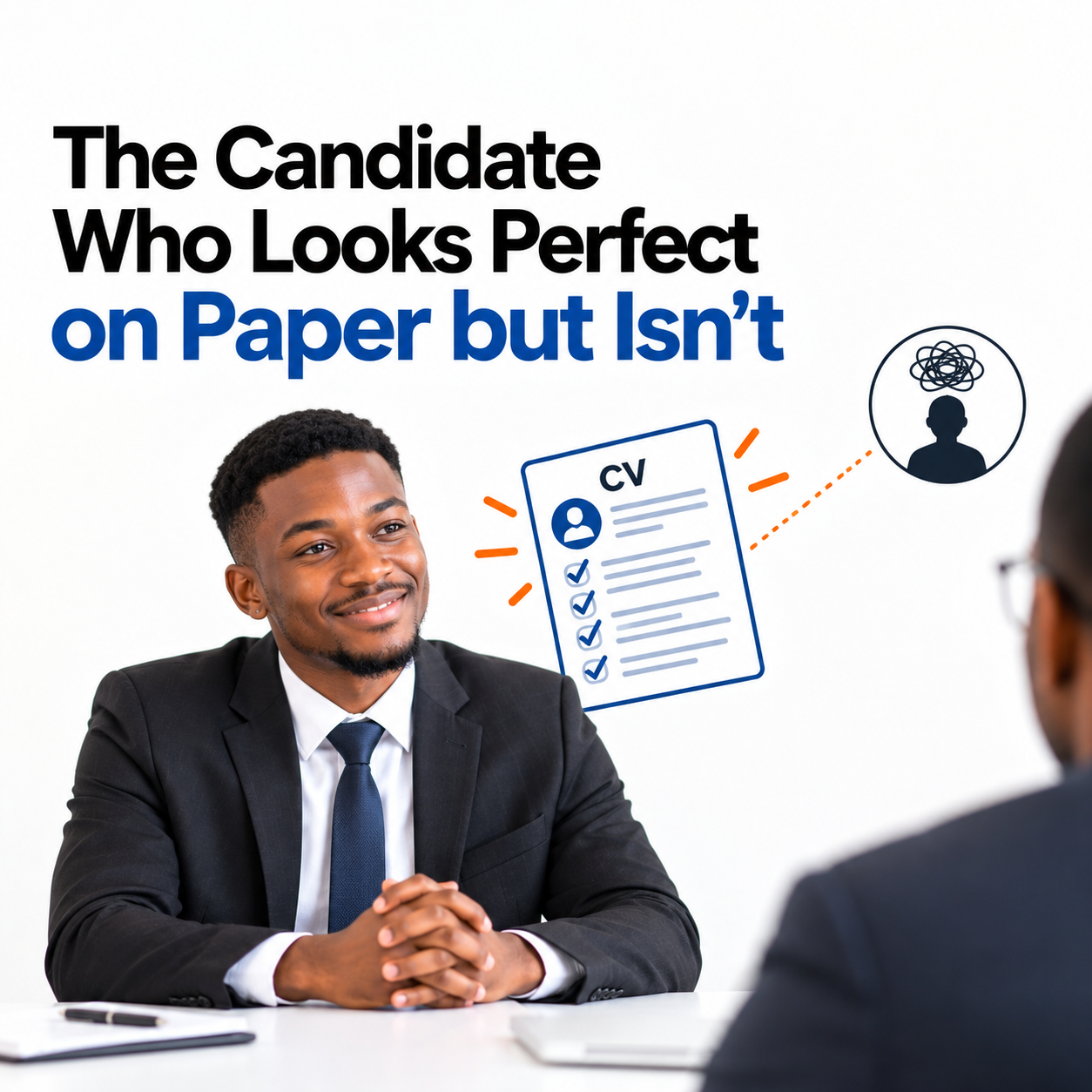
The Candidate Who Looks Perfect on Paper, But Isn't
On paper, they look unbeatable.
Five years of experience.
A polished CV.
The right qualifications.
Big-name companies.
Impressive job titles.
A LinkedIn profile that looks like a career success story.
Then the interview happens.
And suddenly, something doesn't add up.
This is one of the biggest mistakes employers and recruiters make: assuming that a strong CV automatically means a strong candidate.
A CV can tell you where someone has worked. It can tell you what they studied, what roles they have held, and sometimes even what they achieved.
But it cannot always tell you how they think.
It cannot tell you how they handle pressure, receive feedback, solve problems, communicate with others, or respond when things don't go according to plan.
And those qualities often determine whether someone succeeds in a role.
The CV Is the Highlight Reel
Think about a CV as a professional highlight reel.
People naturally include their best experiences, biggest achievements, impressive titles, and strongest skills.
There is nothing wrong with that.
But hiring someone based entirely on their CV is like hiring a footballer because you watched their best five minutes.
You still need to see how they perform when the game gets difficult.
A candidate may have worked for a well-known company, but what exactly did they do there?
They may have an impressive job title, but what responsibilities came with it?
They may list ten skills, but can they demonstrate those skills when faced with a real problem?
The CV gives you the starting point. It should not be the final decision.
What Happens When the Interview Begins?
This is where the difference between a great CV and a great candidate often becomes clear.
Some candidates can write excellent CVs but struggle to explain their own achievements.
Others can list impressive responsibilities but cannot explain the impact of their work.
Some may have all the qualifications required but struggle when asked a practical question.
That does not necessarily mean they are bad candidates.
It simply means the CV did not tell the whole story.
The interview gives employers an opportunity to look beyond the polished document and understand the person behind it.
What Should You Look For Instead?
Don't just ask:
"Does this candidate have the experience?"
Ask:
- Can they explain their achievements clearly?
- Do they understand the problems they were solving?
- Can they give specific examples?
- Do they take responsibility for mistakes?
- Can they adapt when circumstances change?
- Do they ask thoughtful questions?
- Can they demonstrate how they would approach a real problem?
- Can they explain what they learned from difficult situations?
- Can they work effectively with other people?
The strongest candidates are rarely the ones who simply know how to sound impressive.
They are the ones who can demonstrate the thinking behind their experience.
Experience Is Not the Same as Capability
This is an important distinction.
Someone can have ten years of experience and still have repeated the same year ten times.
Another candidate may have three years of experience but have learned, adapted, taken on bigger responsibilities, and consistently delivered results.
Years on a CV are a useful signal.
They are not proof of capability.
Experience tells you what someone has been exposed to.
Capability tells you what they can actually do with that experience.
That is why employers should look beyond the number of years and explore the quality of those years.
Don't Ignore Soft Skills
Technical skills are important.
Qualifications are important.
Experience is important.
But what happens when the candidate has to work with a difficult colleague?
What happens when a project fails?
What happens when their manager gives them critical feedback?
What happens when priorities suddenly change?
What happens when they do not know the answer?
These situations reveal qualities that a CV cannot always capture.
Communication, emotional intelligence, adaptability, accountability, problem-solving, teamwork, and willingness to learn can have a major impact on performance.
A candidate does not need to be perfect.
But they should be able to learn, adapt, and grow.
Look for Evidence, Not Just Claims
Anyone can write:
"Excellent communicator."
"Strong problem-solver."
"Great team player."
But what evidence supports those statements?
Instead of accepting claims at face value, ask candidates to provide examples.
Ask them to describe a difficult problem they faced.
Ask what they did.
Ask why they made that decision.
Ask what happened next.
Ask what they would do differently today.
These questions help reveal whether the candidate has actually developed the skills they claim to have.
The goal is not to catch candidates out.
The goal is to understand how they think and operate.
The Candidate Who Looks Less Impressive
Sometimes, the candidate with the most impressive CV is not the best person for the role.
And sometimes, the candidate with fewer big-name companies, fewer qualifications, or less experience turns out to be exactly what the organisation needs.
Why?
Because they may bring curiosity.
They may be willing to learn.
They may solve problems differently.
They may communicate well.
They may take ownership.
They may have the right attitude and potential to grow.
A candidate should not be judged only by how impressive their history looks.
Their potential matters too.
The Lesson for Hiring Managers
Don't hire the CV.
Hire the person behind it.
Use the CV to decide who deserves a closer look.
Then use interviews, assessments, references, and realistic scenarios to understand whether that person can actually do the work.
Look for evidence.
Ask better questions.
Test relevant skills.
Understand how candidates think.
And give promising candidates an opportunity to demonstrate what they can do, not just what they have written on a page.
Because the perfect candidate on paper can still be the wrong hire.
And sometimes, the candidate who looks less impressive on paper is the one who turns out to be exactly what the business needed.
The CV opens the door. What happens after the door opens is what really matters.
#jobnixafrica #JobSearch #CareerGrowth #CareerTips #JobSeekers #CVTips #ResumeTips #Employability #CareerDevelopment #Hiring #Recruitment #TalentAcquisition #AfricanTalent #NigeriaJobs