Career insights
Remote Work vs. Office Work: Pros and Cons
By Jobnix Team
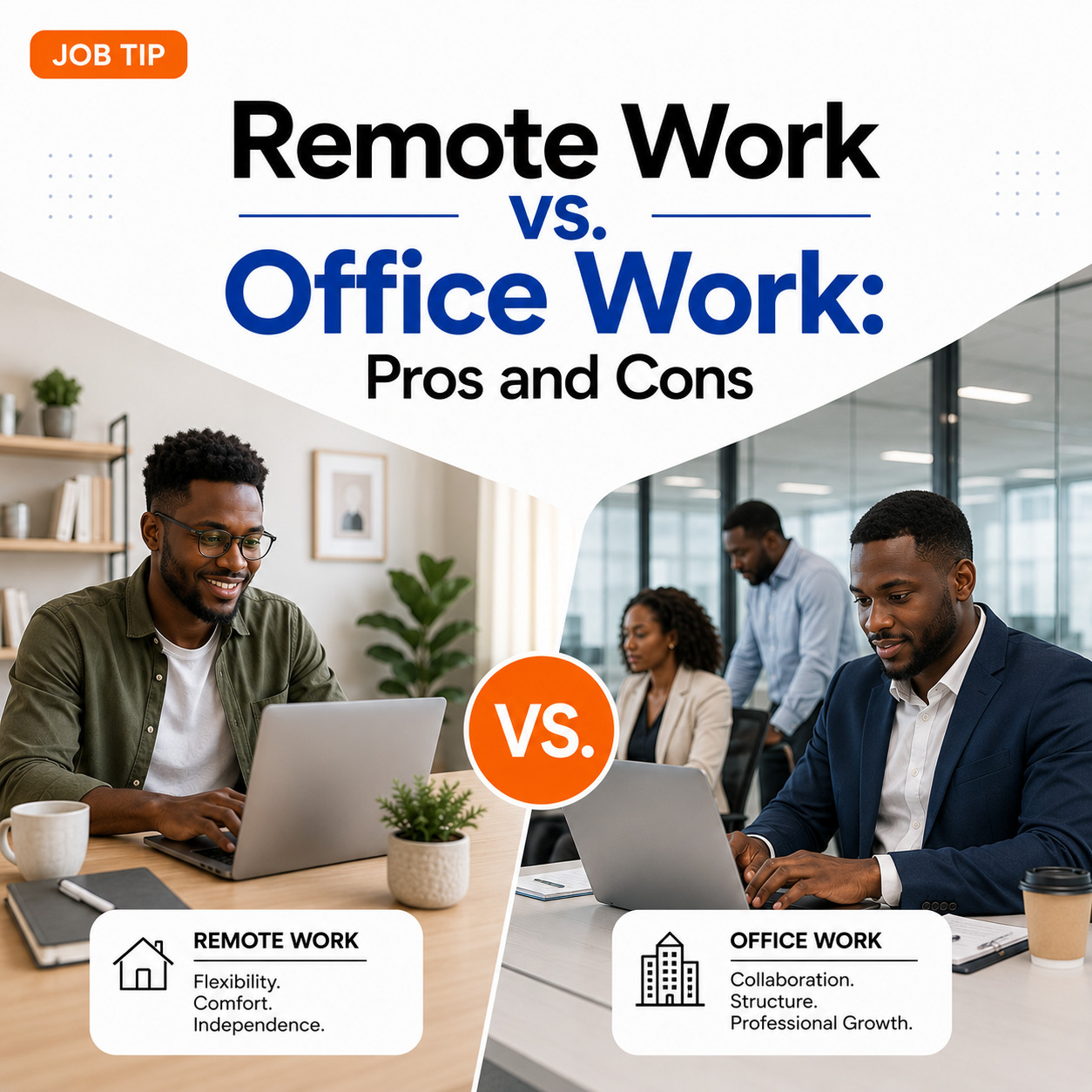
The debate isn't going away anytime soon. Some companies are calling employees back to the office full-time, while others are doubling down on remote or hybrid models. So which one is actually better for you, and for your career?
The honest answer: it depends on what you value most. Here's a clear breakdown to help you think it through.
The Case for Remote Work
Flexibility and autonomy. You control your schedule, your environment, and often your hours as long as the work gets done. For people with families, long commutes, or side projects, this alone can be life-changing.
No commute. Time and money saved on transport adds up fast both in Lagos traffic and in most major cities globally. That's hours back in your day, every single day.
Access to more opportunities. Remote work opens the door to jobs outside your city even outside your country. A Nigerian graphic designer can work for a client in Toronto without relocating.
Often better focus. Away from office interruptions meetings that could've been emails, constant tapping on your shoulder many people report getting more done in less time when remote.
The Case for Office Work
Structure and separation. For a lot of people, having a physical office makes it easier to switch into "work mode" and switch out of it at the end of the day. Remote work can blur that line until you're never really "off."
Stronger relationships and visibility. Face-to-face interaction builds trust faster. It's also easier to be noticed for promotions and new opportunities when you're physically present and part of daily office conversations.
Better for learning and mentorship. Especially early in your career, being in the room matters. Watching how experienced colleagues handle a client call or a tough decision teaches things no onboarding document can.
Fewer distractions at home. Not everyone has a quiet, dedicated workspace. For some, home comes with its own set of interruptions family, noise, or the temptation to multitask on chores.
What Employers Are Weighing
Companies aren't choosing sides randomly either. Remote work can cut office costs and widen the talent pool, but it also makes culture-building, onboarding, and spontaneous collaboration harder to manage. That's part of why so many are settling on hybrid models a middle ground that tries to capture the best of both.
So, Which Should You Choose?
Ask yourself:
- Do I do my best work with structure, or with freedom?
- Am I early in my career and need mentorship and visibility, or am I experienced enough to work independently?
- Do I have a workspace at home that lets me focus?
- How much do I value time saved on commuting versus in-person relationships?
There's no universally "right" answer only the right fit for where you are in your career and what your life currently looks like. The good news is that more companies than ever are offering a choice. Know what you actually want before you're asked to pick.