Career insights
If Every Nigerian Had a Professional Profile, What Would Change?
By Jobnix Team
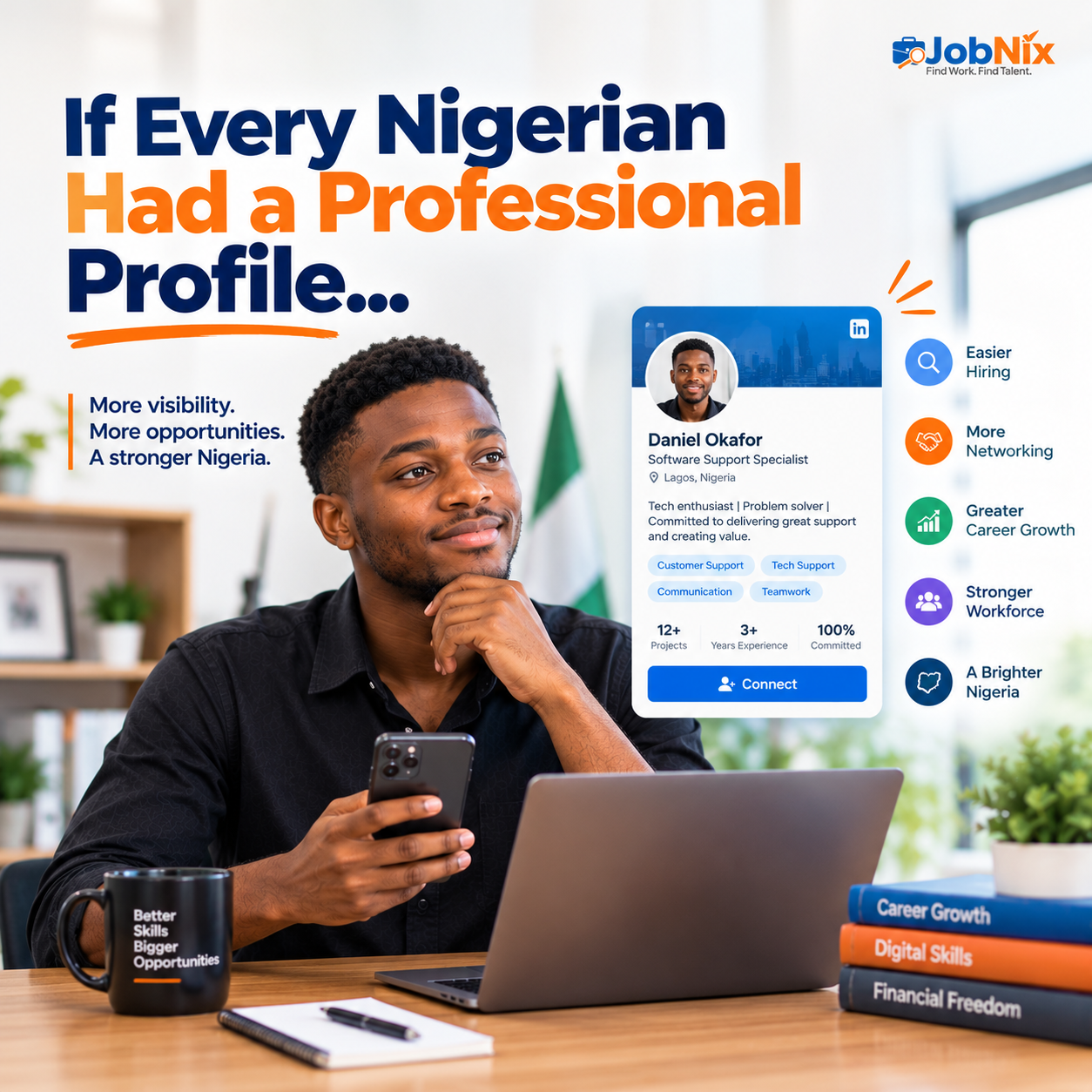
Imagine a Nigeria where every person had a professional profile.
Not just graduates looking for jobs. Not just corporate professionals updating their LinkedIn pages. Everyone.
The student learning a new skill, the entrepreneur building a business, the fashion designer creating beautiful pieces, the mechanic solving complex technical problems, the freelancer working from home, and the young person still figuring out their career path.
Imagine if all these people had a place to showcase who they are, what they can do, what they have achieved, and what they hope to accomplish.
What would change?
More than we might think.
Nigeria Is Full of People With Something to Offer
Every day, Nigerians develop skills, solve problems, build businesses, and create value in ways that often go unnoticed.
Someone is learning software development from their bedroom. Someone else is building a small business with limited resources. A university student is managing a side hustle while studying. An artisan is perfecting a craft they have practised for years.
These individuals may not have impressive job titles or extensive professional networks, but they have something valuable: the ability to do something that matters.
The challenge is that not everyone has a way to communicate that value beyond their immediate environment.
Their skills may be known only to friends, family, customers, or a handful of colleagues. Their achievements might exist only in social media posts, private conversations, or personal experiences that never make it onto a CV.
As a result, opportunities can pass them by, not necessarily because they lack the ability to succeed, but because the people who need their skills cannot find them.
What if we could change that?
What Exactly Is a Professional Profile?
A professional profile is more than a collection of qualifications and job titles.
It is a representation of who someone is professionally, what they know, what they can do, and the value they can offer.
It can showcase skills, work experience, projects, achievements, certifications, interests, and professional goals.
For someone with years of experience, it can tell the story of their career.
For a student, it can showcase projects, volunteer work, and developing skills.
For an entrepreneur, it can highlight a business, the problems it solves, and the work involved in building it.
For someone who has never held a formal job, it can provide a starting point for communicating their abilities and ambitions.
The goal is not to replace the CV. It is to give people more ways to present themselves professionally.
After all, a person's professional identity should not begin and end with their current employment status.
What If Talent Became Easier to Discover?
Consider a small business owner in Lagos searching for a graphic designer.
They might ask friends for recommendations, search social media, or post a vacancy and hope the right person applies.
Now imagine being able to discover people based on their design skills, portfolios, experience, location, and availability.
A talented designer who has never worked for a major company could still demonstrate their ability through completed projects.
The same principle applies across industries.
A business could find a marketer who has helped small brands grow. An entrepreneur could discover a developer with experience building similar products. A customer could find a skilled technician with relevant experience. A young professional could connect with someone willing to offer mentorship.
The possibilities become even more interesting when people can discover one another based on what they can do, rather than relying exclusively on who they already know.
Of course, a profile alone does not guarantee employment or trust. People still need to demonstrate their abilities, and organisations must evaluate candidates carefully.
But making professional information easier to discover could open doors that might otherwise remain closed.
A Professional Identity for More Than the Privileged Few
Access to professional opportunities is not always equal.
Some people have access to influential networks, prestigious institutions, career guidance, and platforms that make their achievements visible.
Others possess valuable skills but lack the exposure or connections needed to communicate their value.
A professional profile could help narrow this visibility gap.
A young person outside Nigeria's major commercial centres could showcase their work to potential clients elsewhere. A self-taught professional could demonstrate practical skills. An experienced artisan could present their services to a wider audience.
Their background would still matter in certain contexts, and digital access would remain a challenge for some people.
However, a more accessible professional discovery system could give more Nigerians a way to participate in opportunities beyond their immediate circles.
Where you come from should not be the only thing people know about you.
They should also have a chance to discover what you can contribute.
Imagine the Possibilities
Imagine a Nigeria where students begin building professional identities before graduation.
Where freelancers can showcase their work beyond social media.
Where entrepreneurs can discover potential collaborators.
Where employers can find candidates through demonstrated skills and relevant experience.
Where people changing careers can document their progress and communicate their readiness for new opportunities.
Where skilled workers can make their experience visible to people who need their services.
This is not simply about creating profiles. It is about creating connections between people and possibilities.
A useful professional profile should help answer three important questions:
- Who are you?
- What can you do?
- What opportunities could be right for you?
When people can answer these questions clearly, they become better positioned to communicate their value and pursue relevant opportunities.
When organisations can find these answers more easily, they may discover talent they would otherwise overlook.
The Future of Professional Visibility in Nigeria
Nigeria does not lack people with ambition, creativity, and valuable skills.
What we need are better ways to help people communicate those abilities and connect with opportunities.
A professional profile cannot solve unemployment, eliminate inequality, or guarantee success. Those challenges require broader economic, educational, and institutional changes.
But professional visibility can be part of the solution.
It can help people tell their stories, showcase their development, and make their capabilities easier to discover.
It can encourage young people to start documenting what they learn and build.
It can help experienced professionals communicate the value of their work.
And it can remind organisations that talent may exist outside the familiar networks they have always relied on.
Final Thoughts
What if every Nigerian had a professional profile?
Perhaps more people would have opportunities to demonstrate their abilities.
Perhaps businesses would discover talent in unexpected places.
Perhaps students would begin thinking about their professional identities earlier.
And perhaps we would become better at recognising that a person's potential is not always reflected in their job title, educational background, or employment history.
The real opportunity is not to put every Nigerian online simply for the sake of it.
It is to make it easier for people to be seen for what they can do.
Because when people become easier to discover, new connections become possible.
And sometimes, the difference between having talent and finding an opportunity is simply being seen by the right person.
What could Nigeria become if we made it easier to discover the talent that already exists?