Career insights
Degrees vs. Skills: What Do Employers Really Want?
By Jobnix Team
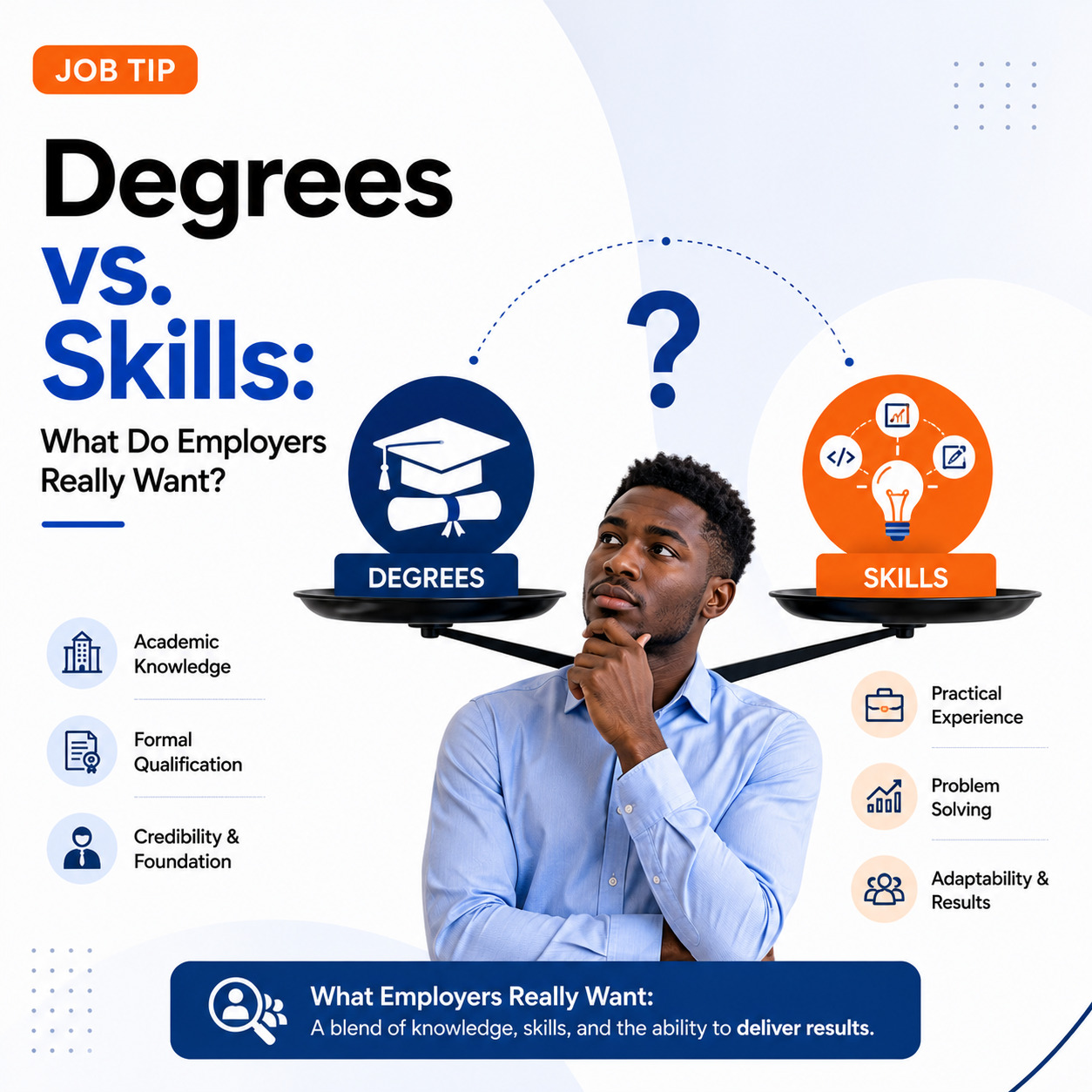
For decades, a degree was treated as proof that a candidate was ready for work. That assumption is shifting. Employers across Nigeria are increasingly hiring based on what a candidate can actually do, not just what certificate they hold. This does not mean degrees have become worthless. It means they are no longer the only, or even the main, thing being evaluated.
Why the Shift Is Happening
Companies have noticed a gap between academic performance and job readiness. A strong degree does not always translate into someone who can write a clear email, manage a spreadsheet, or handle a difficult customer. As business needs move faster than academic curricula can update, employers have started testing for practical ability directly, instead of assuming a degree guarantees it.
Where Degrees Still Matter
Certain fields still require a degree as a baseline, and in some cases a legal requirement. Medicine, law, engineering, and accounting are clear examples, where regulatory bodies require specific qualifications before a person can practice. In these fields, the degree is not optional, it is the entry ticket.
Where Skills Are Taking Over
In fields like digital marketing, customer support, sales, content creation, and increasingly even entry level tech roles, employers are placing far more weight on demonstrated skill than on the specific degree listed on a CV. A candidate who can show a portfolio, a project, or a clear example of results is often considered ahead of a candidate with only a degree and no evidence of applied ability.
What Employers Are Actually Testing For
Recruiters are not asking "does this person have a degree." They are asking whether the candidate can solve the specific problems the role requires. This is why skills assessments, practical tests, and portfolio reviews are becoming more common during hiring, even for roles that used to rely purely on CV screening.
How to Position Yourself Either Way
● If you have a degree but limited practical experience, look for ways to demonstrate skill directly, through small projects, volunteer work, or freelance tasks.
● If you do not have a degree, focus your CV and interview answers on specific, provable outcomes rather than apologizing for the missing qualification.
● Research whether the specific role or industry legally requires a degree before assuming skills alone will be enough.
● Keep building visible proof of ability, since this now carries as much weight as formal education in many hiring decisions.
Find Roles That Value What You Can Actually Do
Jobnix lists roles across industries where practical skill is explicitly valued alongside or instead of formal qualifications. Visit jobnix.ng to find opportunities that match what you can do, not just what is printed on your certificate.