CV & Cover Letter
10 CV Mistakes That Can Cost You Your Dream Job
By Jobnix Team
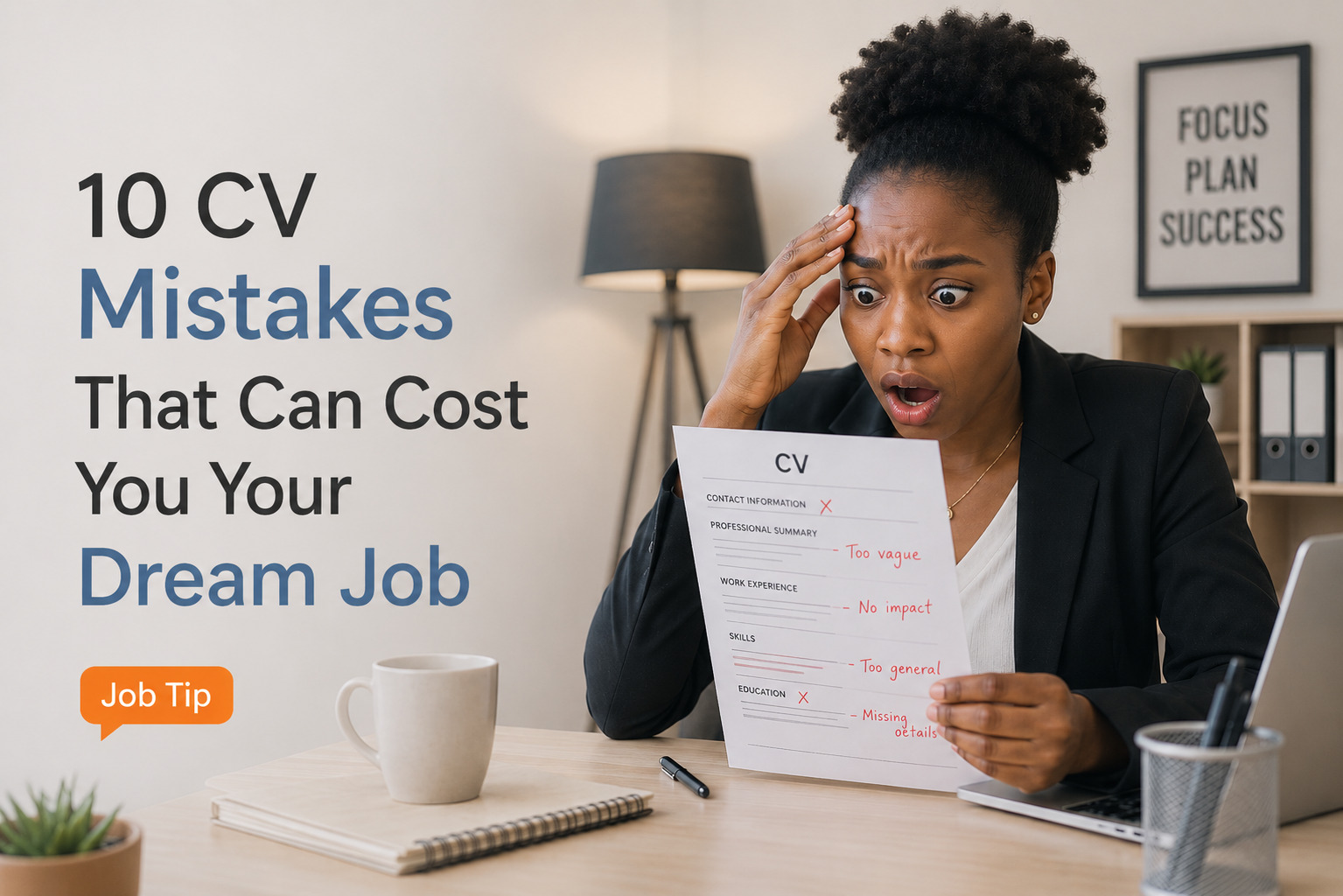
A CV has one important job: to convince an employer that you are worth interviewing.
You may have the right qualifications, years of experience and professional skills required for a position. You may even be more qualified than some of the people applying for the same vacancy. But if your CV does not communicate your value effectively, recruiters may overlook your application before discovering what you can actually offer.
This is one of the frustrating realities of job searching.
Imagine spending several hours preparing your CV, carefully listing your qualifications, arranging your employment history and checking every detail before submitting your application. You expect the recruiter to appreciate the effort. However, recruiters often have hundreds of applications to review, and they cannot dedicate several minutes to every document.
They need to identify relevant information quickly. They want to understand your professional background, experience, competencies and suitability for the position without having to search through unnecessary details.
Unfortunately, many job seekers make avoidable mistakes that weaken their applications. Some use the same CV for every vacancy, while others focus too much on listing responsibilities instead of demonstrating their achievements. There are also candidates who submit poorly formatted documents, overlook spelling errors or fail to include important information.
The good news is that most of these mistakes can be corrected.
Whether you are a fresh graduate, an experienced professional or someone considering a career change, understanding these common CV mistakes can help you present yourself more effectively.
Here are ten mistakes you should avoid when preparing your next job application.
1. Using One CV for Every Job Application
One of the most common mistakes job seekers make is preparing a single CV and sending it to every employer, regardless of the position being advertised.
It may seem convenient, particularly when you are applying for several vacancies. After all, you have already listed your qualifications, employment history and skills. Why should you keep changing the same document?
The problem is that different employers are looking for different things.
A company recruiting an Administrative Officer may prioritise documentation, office coordination, record management and communication skills. Meanwhile, an organisation hiring a Human Resources Officer may be more interested in recruitment, employee relations, personnel administration and performance management.
Even if you have experience in both areas, presenting exactly the same CV for both positions may prevent recruiters from recognising the most relevant parts of your background.
A generic CV often communicates everything you have done without explaining why your experience makes you suitable for a particular vacancy.
How to fix it:
Start by reading the job description carefully. Identify the responsibilities, qualifications, experience and competencies the employer considers important.
Then adjust your CV to highlight the parts of your professional background that relate to those requirements.
You do not need to create an entirely new CV for every application. Instead, maintain a comprehensive master CV containing your qualifications, experience, skills and achievements. Use it as the foundation for preparing tailored versions for different positions.
For example, if you are applying for an administrative position, bring your documentation, reporting and office coordination experience forward. If you are applying for a customer service position, emphasise your communication, complaint resolution and customer relationship skills.
The objective is to help the recruiter see the connection between your experience and the vacancy.
2. Listing Job Responsibilities Instead of Achievements
Your CV should explain what you did in previous positions, but it should also demonstrate how effectively you performed those responsibilities.
Unfortunately, many CVs read like copied job descriptions.
You will often find statements such as:
- Responsible for handling customer complaints.
- Assisted with daily administrative activities.
- Managed company records.
- Participated in sales and marketing activities.
- Supervised junior employees.
These statements are not necessarily wrong. However, they do very little to distinguish you from other candidates who performed similar duties.
An employer already has an idea of what an Administrative Officer, Sales Representative or Customer Service Executive is expected to do. What they want to understand is how you contributed to the organisation.
For instance, there is a difference between saying you handled customer complaints and explaining that you improved complaint resolution by introducing a more organised follow-up process.
The second statement communicates initiative and contribution.
How to fix it:
Where possible, transform your responsibilities into achievement-focused statements.
Consider these examples:
Instead of: Responsible for sales activities.
Write: Contributed to a 20% increase in monthly sales within four months through improved customer engagement and follow-up strategies.
Instead of: Managed company documentation.
Write: Maintained accurate operational records and improved document retrieval through organised filing procedures.
Instead of: Supervised employees.
Write: Coordinated the daily activities of an eight-member team, ensuring tasks were completed according to operational schedules.
You do not have to invent extraordinary achievements. Even improvements in accuracy, organisation, customer satisfaction, productivity and teamwork can demonstrate professional value.
The important thing is to explain your contribution rather than simply repeat your job description.
3. Failing to Include Numbers and Measurable Results
Numbers can make a significant difference in how recruiters interpret your achievements.
Imagine reading two CVs from candidates who have both worked in sales.
The first candidate writes, "Experienced in increasing company sales."
The second writes, "Increased monthly sales by 25% over six months through improved customer engagement and targeted sales activities."
The second statement provides a clearer indication of the candidate's contribution.
Numbers give context to professional achievements. They help employers understand the scale of your responsibilities and the results of your work.
This is particularly useful for professionals working in sales, marketing, operations, finance, administration, customer service and project management.
However, measurable achievements are not limited to revenue or percentages.
You can demonstrate your contribution through the number of employees supervised, customers served, projects completed, reports prepared, transactions processed or deadlines consistently achieved.
For example:
- Managed daily customer enquiries from more than 50 clients.
- Coordinated recruitment activities for 15 vacancies across different departments.
- Supervised a team of 12 employees during routine operational activities.
- Processed over 100 administrative records weekly.
- Successfully delivered six projects within agreed timelines.
How to fix it:
Review your previous work experience and identify activities where you can provide reliable figures.
Ask yourself:
- How many people did I supervise?
- How many customers did I support?
- How many projects did I complete?
- Did I help increase revenue or reduce operational costs?
- Did I improve turnaround time or productivity?
- How frequently did I perform particular responsibilities?
If you cannot remember exact figures, use accurate estimates only where you can reasonably support them. Never invent statistics to make your CV appear impressive.
Your achievements do not need to be extraordinary. They simply need to communicate what you contributed and why it mattered.
4. Making Your CV Unnecessarily Long
Some job seekers believe that a longer CV automatically demonstrates greater experience and professionalism.
As a result, they include almost everything they have done since leaving secondary school, even when much of the information has little connection to the position they are pursuing.
A CV can easily become three or four pages long because it contains irrelevant employment history, outdated responsibilities, unnecessary personal information and certificates that do not strengthen the application.
The problem is not necessarily the number of pages. It is the quality and relevance of the information.
An experienced professional with 15 years of relevant work history may reasonably need more than two pages. However, a recent graduate with limited experience may struggle to justify a lengthy document.
Recruiters need to identify the information that matters without navigating unnecessary content.
How to fix it:
Focus on relevance rather than trying to include everything.
For many entry-level and mid-career professionals, one or two pages can be sufficient. More experienced candidates may require additional space depending on their industry and career history.
Prioritise:
- Recent and relevant employment history.
- Important professional achievements.
- Relevant educational qualifications.
- Technical and professional competencies.
- Certifications that support your application.
Older employment experiences can be summarised if they do not contribute significantly to the position you are applying for.
You should also avoid repeating the same responsibilities under multiple employers.
Remember, a good CV is not a complete autobiography. It is a professional document designed to demonstrate your suitability for a particular opportunity.
5. Poor Formatting and Inconsistent Structure
Your CV may contain impressive qualifications and valuable experience, but poor formatting can make the document difficult to understand.
Imagine opening a CV with several different fonts, inconsistent heading sizes, crowded paragraphs, irregular spacing and information scattered across the page.
Even if the candidate is qualified, the presentation makes the recruiter work harder to identify important details.
A professional CV should be organised in a way that allows someone to move naturally from one section to another.
Your name and contact information should be easy to locate. Your professional summary should be visible near the top, followed by your work experience, education and relevant skills.
There should also be a clear distinction between different positions and employers.
How to fix it:
Use a clean, professional layout that prioritises readability.
Consider the following:
- Choose readable fonts such as Arial, Calibri or Aptos.
- Maintain consistent font sizes throughout the document.
- Use clear headings for different CV sections.
- Apply consistent spacing between paragraphs and sections.
- Use bullet points to organise responsibilities and achievements.
- Avoid excessive colours, decorative graphics and unnecessary design elements.
- Ensure that dates, job titles and company names follow a consistent format.
You should also consider how your CV will appear on different devices and when opened by recruitment software.
A visually attractive design is not necessarily an effective CV design. Some highly decorative layouts can make information difficult for Applicant Tracking Systems to interpret.
The priority should be a document that looks professional, remains readable and communicates your experience clearly.
6. Spelling and Grammar Errors
A spelling mistake may appear insignificant to the person preparing a CV, but it can create an unnecessary negative impression.
Consider a candidate applying for a position that requires strong communication skills. Their CV contains several grammatical errors, inconsistent punctuation and incorrectly spelt words.
Even if their professional experience is impressive, the recruiter may begin questioning their attention to detail.
This does not mean every employer will automatically reject a candidate because of one typo. However, repeated errors can make a document appear rushed and poorly prepared.
Some mistakes are particularly easy to overlook because you become familiar with your own writing after reading it several times.
You may also accidentally leave information from an earlier application, such as the wrong company name or an outdated job title.
How to fix it:
Do not rely entirely on your ability to identify errors while typing.
After completing your CV:
Read the entire document slowly.
Use a spelling and grammar checker.
Check the consistency of dates, names and job titles.
Confirm that every sentence communicates what you intend.
Ask another person to review the document before submitting it.
Reading your CV aloud can also help you identify awkward sentences and missing words.
Pay particular attention to your professional summary and work experience sections because these areas communicate your qualifications and professional value.
A well-written CV does not require complicated vocabulary. Clear, accurate and professional language is more effective than unnecessarily complex expressions.
7. Writing a Weak or Missing Professional Summary
Your professional summary is often one of the first sections a recruiter encounters after opening your CV.
Yet many candidates either omit it completely or fill the space with generic statements that provide little information about their professional background.
Expressions such as "I am hardworking, dedicated, honest and passionate about success" are common, but they do not explain what you can actually contribute to an organisation.
Almost every applicant can describe themselves using these qualities.
A strong professional summary should communicate your professional identity, relevant experience and major competencies.
For example, consider the following:
Weak summary:
"I am a hardworking and dedicated individual seeking a challenging position in a reputable organisation where I can utilise my skills and contribute to organisational growth."
Stronger summary:
"Administrative professional with three years of experience in office coordination, documentation, records management and operational support. Skilled in preparing reports, maintaining accurate records and coordinating administrative activities to support efficient business operations."
The second example provides more useful information about the candidate.
How to fix it:
Write a concise professional summary that answers three important questions:
- What is your professional background?
- What relevant experience and competencies do you possess?
- What value can you bring to the organisation?
For experienced professionals, include years of experience where appropriate. Fresh graduates can focus on their academic background, relevant projects, internships, practical training and transferable skills.
Avoid writing a lengthy personal statement. A few carefully written sentences are usually enough to introduce your professional profile.
8. Including Irrelevant Information
A CV should contain information that helps an employer evaluate your suitability for a position.
Unfortunately, some candidates include details that contribute very little to their applications.
This may include unrelated hobbies, excessive personal information, old certificates, irrelevant employment history or descriptions of activities that have no connection to the vacancy.
For example, someone applying for a finance position may not need to dedicate several lines to an unrelated secondary school activity, particularly if they already have years of relevant professional experience.
This does not mean personal interests and additional experiences are always inappropriate. Certain hobbies can demonstrate valuable qualities, while volunteering and extracurricular activities may be particularly useful for candidates with limited employment history.
The issue is whether the information strengthens your application.
How to fix it:
Review every section of your CV and ask yourself whether the information supports your suitability for the position.
Keep details that demonstrate relevant competencies, professional development, achievements or transferable experience.
Remove unnecessary information that makes the document longer without adding meaningful value.
For example, if you are applying for a project coordination position, volunteering experience involving event planning, team coordination or resource management may be worth including.
However, unrelated information should not occupy space that could be used to highlight your professional strengths.
Your CV should tell a focused professional story.
9. Using an Unprofessional Email Address or Omitting Contact Details
Your contact information may seem like a minor part of your CV, but it is essential to the recruitment process.
After reviewing your application, a recruiter needs a reliable way to contact you.
Imagine finding a suitable candidate but discovering that the email address provided is incorrect or the telephone number is incomplete.
You may never know that an employer attempted to reach you.
Your email address also contributes to the overall impression of your application.
An address such as "sweetboy001@" or "prettylady2020@" may not create the professional impression you want, particularly when applying for corporate positions.
How to fix it:
Use a simple and professional email address, preferably based on your name.
For example:
- john.doe@gmail.com
- john.doe2026@outlook.com
- johndoe@gmail.com
If your preferred address is unavailable, use a reasonable variation that still looks professional.
Also ensure that your CV includes:
- Your full professional name.
- An active telephone number.
- A professional email address.
- Your city or general location.
- A LinkedIn profile, where relevant and properly maintained.
You generally do not need to include your full residential street address.
Before submitting your application, test your email address and confirm that your phone number is correct.
These details may appear simple, but they can determine whether an employer can reach you when an opportunity arises.
10. Ignoring Keywords From the Job Description
Another common mistake is preparing a CV without considering the specific language used in the job advertisement.
Many organisations use Applicant Tracking Systems (ATS) to manage recruitment applications. These systems can help employers organise CVs, search for specific information and identify candidates whose experience matches particular requirements.
For example, a company recruiting a Procurement Officer may mention keywords such as:
- Procurement planning.
- Vendor management.
- Inventory control.
- Contract negotiation.
- Supply chain coordination.
- Purchase order management.
A candidate may have experience performing these responsibilities but describe them using completely different terminology.
As a result, relevant experience may not be immediately recognised during an initial software-assisted or human review.
This is why understanding the job description is important.
How to fix it:
Read the vacancy carefully and identify the important skills, qualifications, software, responsibilities and industry-specific terms.
Where they genuinely reflect your experience, incorporate these terms naturally into your professional summary, skills section and employment history.
For example, if an employer requests experience in customer relationship management, highlight your actual experience maintaining customer records, managing enquiries, resolving complaints and supporting client relationships.
Do not simply copy the entire job advertisement into your CV.
Avoid filling your document with repeated keywords or claiming skills you do not possess. Your CV must remain accurate and should be easy for both recruitment software and human readers to understand.
The objective is to make your relevant experience easier to identify, not to manipulate the recruitment process.
Quick CV Checklist Before You Apply
Before submitting your next application, take a few minutes to review your CV against this checklist.
My CV is tailored to the specific vacancy.
My professional summary clearly explains my background.
My most relevant experience is easy to identify.
My work descriptions highlight achievements, not just responsibilities.
I have included measurable results wherever possible.
My CV has a clean and consistent layout.
My spelling, grammar and punctuation have been checked.
I have removed unnecessary or irrelevant information.
My employment dates and job titles are accurate.
My contact details are complete and professional.
I have included relevant keywords from the job description.
My qualifications and professional claims are truthful.
I have saved the document in the format requested by the employer.
You do not have to get everything perfect on your first attempt. What matters is developing the habit of reviewing and improving your CV before every application.
Put Your Improved CV to Work
Preparing a strong CV is an important step towards securing employment, but it should not be the only thing you focus on during your job search.
You also need to identify suitable opportunities, understand employer requirements and submit applications that match your qualifications and experience.
A well-prepared CV submitted to an unsuitable vacancy may not produce the results you expect. Equally, a suitable vacancy can become a missed opportunity if your application does not communicate your professional value.
Be intentional about where you apply. Research employers, review job requirements and make sure your application is relevant.
At JobNix Africa, we believe that finding the right opportunity begins with connecting job seekers to relevant employment opportunities and helping them present themselves professionally.
Whether you are a fresh graduate preparing your first professional CV, an experienced employee seeking career advancement or someone transitioning into a new industry, taking the time to improve your application can make a meaningful difference.
Explore available job opportunities and put your improved CV to work.
Visit www.jobnix.ng for job listings and opportunities shared by employers and recruitment partners.
JobNix Africa — Find Work. Find Talent.